Why Your Watch Logs Wake-Ups You Don't Remember

Patricia Bedoya
·
·
6
min read
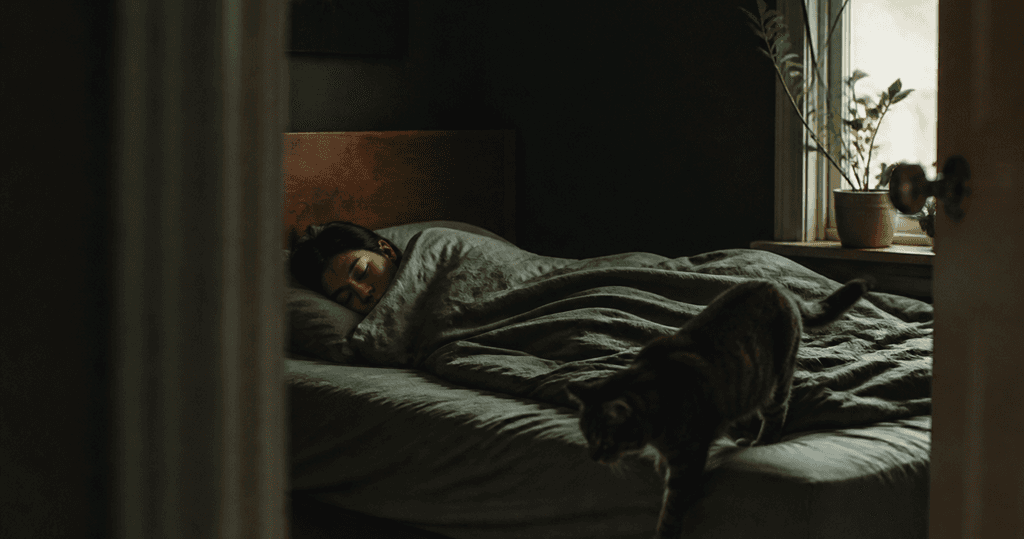
Cover image generated with AI — © Chubby Studio S.L.
KEY TAKEAWAY
Waking briefly many times a night is normal: healthy adults average around 14 arousals per hour in the sleep lab. You do not remember them because an awakening has to last roughly four minutes before it registers in morning memory. Your watch is not inventing them, and Apple's own validation suggests it under-counts true wake time rather than over-counts it.
You open the Health app and last night looks like a barcode. Eleven awake segments scattered across the chart. You remember going to bed, you remember the alarm, and nothing at all in between.
The short version: those wake-ups are almost certainly real, and you were never going to remember them. Brief awakenings are a normal feature of human sleep rather than a fault in it, and an awakening has to last several minutes before it makes it into morning memory. The number on that chart is not a verdict on your night. It is a measurement of something that was always happening, on a night you happened to be wearing a watch.
Is it normal to wake up that many times a night?
Yes, and the clinical picture is far more fragmented than most people imagine. Sleep laboratories score an arousal as an abrupt shift in brain activity lasting at least three seconds, preceded by at least ten seconds of stable sleep. Healthy sleepers collect them all night long. In one polysomnography study of 28 healthy adults, the average arousal index was 14.2 per hour, and participants spent an average of 28 minutes awake after first falling asleep.
Those participants slept a little over six hours each, which works out at close to ninety arousals per night. Most are far too brief for any wrist device to register, let alone for you to notice. The handful your watch does surface are the longer ones: the turn onto your other side, the moment the room got too warm, the end of a sleep cycle where you came close enough to the surface to shift position.
Fragmentation also rises with age, steadily and normally. A sleep chart with visible wake-ups is what an ordinary adult night looks like, not evidence that something went wrong.
Why don’t you remember any of them?
Because forming a memory takes more continuous wakefulness than a brief awakening provides. Sleep researchers call the effect mesograde amnesia: material from the minutes either side of a sleep transition never gets encoded in the first place, so there is nothing to forget in the morning.
The most direct test of this measured how long an awakening has to last before people report it the next day. Across participants sleeping at home rather than in a laboratory, the threshold averaged 259 seconds, roughly four minutes and twenty seconds, and ranged from 30 seconds to a full ten minutes depending on the person.
So a ninety-second awakening is, for most people, an event that genuinely happened and left no trace whatsoever. You are not misremembering the night, you are remembering as much of it as anyone does. Your watch and your memory are describing two different things, and only one of them was built to keep records.
See your nights as a pattern, not a verdict
FitWoody scores each night against your own sleep goal and your usual patterns, so one fragmented night reads as one night and not a failing grade. 7-day free trial of Plus.
Download the app
★★★★★
4.5 · 732 ratings on the App Store
Is your watch inventing these wake-ups?
This is where the intuition usually goes wrong. The assumption is that a wrist device is trigger-happy, promoting every twitch to an awakening. Apple’s own validation paper says the error runs mostly the other way.
The Apple Watch sleep staging algorithm classifies each 30-second window using accelerometer data, including the small motion your breathing produces. Tested against expert-scored polysomnography over 299 nights from 166 participants, the current version reaches a median sleep sensitivity of 96.8 percent and a specificity of 78.9 percent. Read the second number slowly: about a fifth of the time you were genuinely awake gets logged as sleep, not the reverse.
That is a clear improvement on traditional wrist actigraphy, which the same paper puts at 50 percent specificity or worse. But the direction is what matters here. If your watch reports eleven wake-ups, the honest reading is not that it exaggerated. It is that eleven is a conservative count of something real. For the wider question of how well a wrist device measures sleep at all, we went through the validation evidence separately.
Awake minutes and awakenings are not the same number
Two different things get displayed with almost the same word, and mixing them up causes most of the alarm.
An awakening is an event: one transition out of sleep. Awake minutes are a total: how much of the night was scored as wake, including the stretch before you fell asleep and any time at the end after you surfaced but before you got up. Eleven awakenings adding up to twelve minutes is a completely different night from two awakenings adding up to ninety, and only the second one is worth thinking about.
Sleep scores compress both into one figure, which is why the score and the chart sometimes tell different stories. We wrote separately about how a sleep score gets built and what it flattens.
When are frequent wake-ups worth taking seriously?
Almost never on the strength of the count alone. What deserves attention is a cluster of symptoms, not a number on a chart.
The National Heart, Lung, and Blood Institute lists the nighttime signs of sleep apnea as breathing that starts and stops, frequent loud snoring, and gasping for air, and notes that you often will not know about them until someone else tells you. The daytime side looks like sleepiness and tiredness that interferes with focus and reaction time, dry mouth, headache, and waking often to urinate. If several of those describe you, a fragmented chart is a reason to talk to a doctor, not a reason to rearrange your bedtime routine.
FitWoody does not diagnose anything, and neither does your watch. A consumer device can flag a pattern worth asking about; it cannot rule anything in or out. That distinction is the entire difference between useful tracking and self-diagnosis.
What should you actually do with the number?
Stop reading it as a nightly grade and start reading it as a line on a graph. A single night tells you very little, because arousal counts move with room temperature, alcohol, a late meal, stress, a cold coming on, a partner, a cat. Two weeks of nights tells you whether anything has genuinely changed. That is the case for judging your nights against your own history instead of a published normal range.
It also helps to remember that the chart is not the only evidence you have. If you feel rested on a night the graph calls broken, that disagreement is information rather than an error, and it is usually the chart that needs the caveat.
This is what FitWoody does with the sleep data your watch already collects: it scores each night against your own sleep goal and your usual patterns rather than a population average, so a fragmented Tuesday reads as a fragmented Tuesday and not as a failing grade.
And if the count itself is what is keeping you up, that is worth naming plainly. Studying a fragmentation number before you have had coffee is a habit with a poor return. The best use of a wake-up count is to look at it weekly, or not at all.
Frequently asked questions
How many wake-ups per night is too many?
No count makes a night abnormal on its own. Healthy adults record around 14 brief arousals per hour in laboratory studies, and a wrist device surfaces only the longest of them. What matters is whether the pattern has changed over weeks, and whether you have daytime symptoms such as persistent sleepiness.
Does the Apple Watch use heart rate to detect that you are awake?
Apple's published description of its sleep staging algorithm is accelerometer-based. It classifies each 30-second window using wrist motion, including the subtle movement your breathing produces. Heart rate is recorded overnight but is not what the stage classifier runs on.
Should I stop tracking my sleep if the number worries me?
If checking the chart is making your nights worse, looking at it weekly instead of every morning usually keeps the useful signal and drops the anxiety. Sleep tracking is built to show patterns over time, and no single night's data is worth losing sleep over.